Analytics
All the technology research we are working on deals with real-world samples, which are usually highly complex, mostly hydrocarbon-based oils containing thousands of isomers and many trace contaminants that can affect progress.
Comprehensive analytics, including reliable identification and, in particular, quantification of individual analytes and groups, is therefore key to advances in other topics related to RECYCLING and FUELS.
We focus on developing, optimising, and validating analytical methods to accurately characterise the chemical composition of complex samples, such as alternative fuels, oils from thermochemical processes like pyrolysis and HTL, and products of refining.
Ongoing research
He to H2
Sustainable GC×GC-FID Flow-Modulated System with Hydrogen Carrier Gas: A Manual for Easier Switch from Helium to Hydrogen
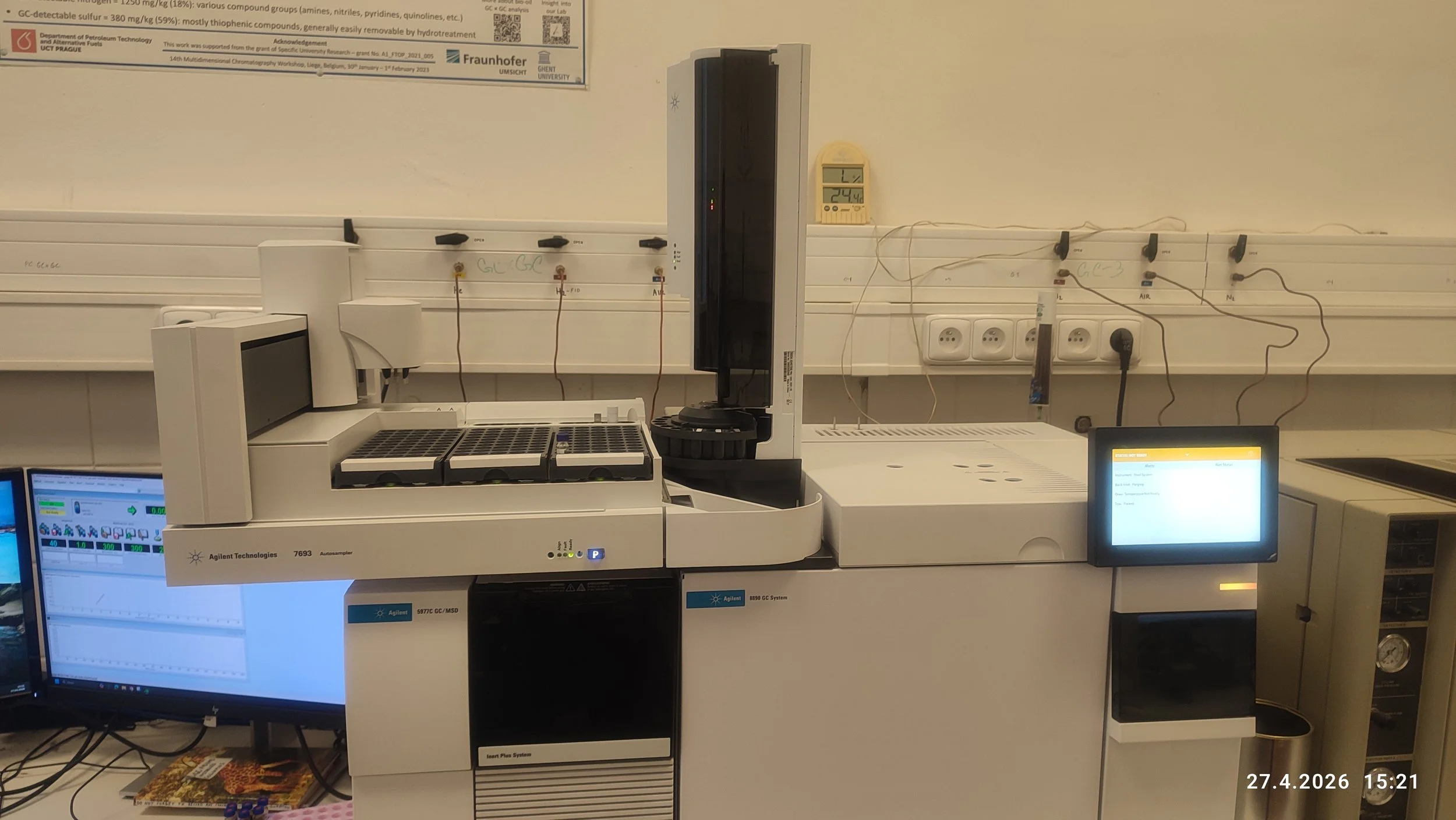
The current trend in GC-MS analysis involves substituting Helium carrier gas with Hydrogen to make the operation more sustainable and cost-effective. However, limited interest was dedicated to two-dimensional GC (GC×GC), whose operation and optimization are far more complicated, especially when equipped with more sustainable, consumables-free flow modulators. Our project focuses on the issue of Helium substitution by Hydrogen for GC×GCas part of its transition to even more sustainable operation. The project findings will result in a step-by-step tutorial for switching any flow-modulated GC×GC method to Hydrogen, including optimizing the FID settings to reach comparable sensitivity.
Find our more about the project
Past research
Olefins determination by GC×GC
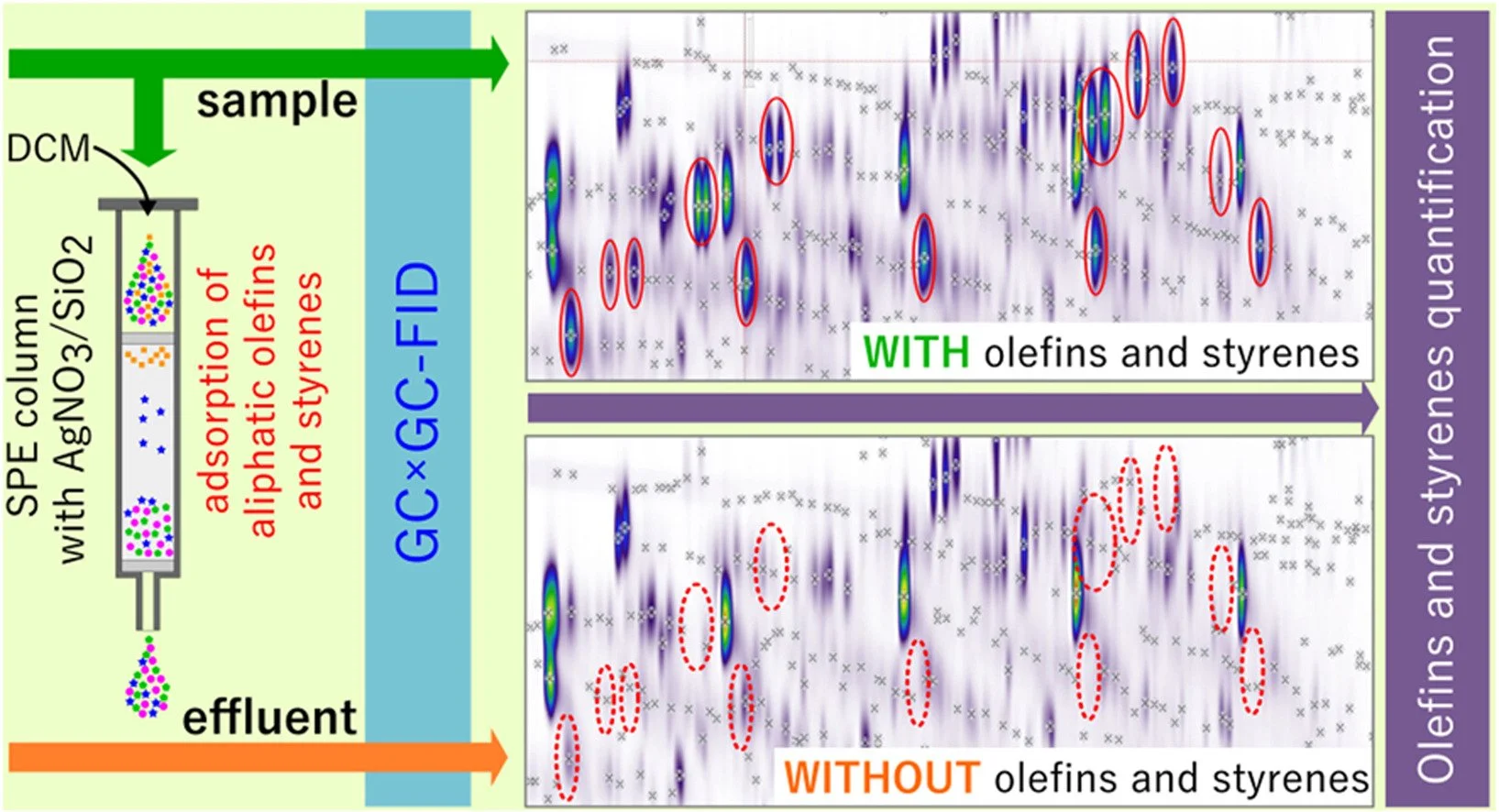
Determination of olefins in pyrolysis oils from waste plastics and tires is crucial for optimizing the pyrolysis process and especially for the further advanced valorization of these oils in terms of the circular economy. Identifying olefins, even using high-resolution techniques like GC×GC, is challenging without TOF-MS, which allows modification of the ionization step. Currently, the only method for determining olefins in plastic pyrolysis oils is GC-VUV. We developed a new method for the selective micro-scale adsorption of olefins over AgNO3/SiO2, followed by GC×GC-FID analysis. Olefins are determined indirectly from the loss of chromatographic area in respective hydrocarbon groups before and after removal. Only 50 μL sample and 15 min of sample separation are needed. Our method was extensively validated and provides a reliable determination of olefin content in a wide range of pyrolysis oils from plastics and tires and their products after mild hydrotreatment. It is affordable to all researchers and industrial companies working on plastics recycling by thermochemical processes as it does not require an MS detector.
Plastic pyrolysis oil analysis
Since 2022, we have participated in a project focused on waste plastics and tyre pyrolysis to produce alternative feedstocks for refineries.
Although the oils produced by pyrolysis look similar to fossil samples, their composition differs dramatically. One perspective is that olefins are present, whereas they are nearly absent in fossil samples. A second view is that isomers are not uniformly distributed because cracking during pyrolysis may favour certain products for some polymer types.
In recent years, we have focused on reliably determining olefins (beyond the method commented above), as well as aromatics in those samples.
Feel free to check our publications or contact us if you need help or are interested in collaboration in this direction.