
NEW publication in Fuel
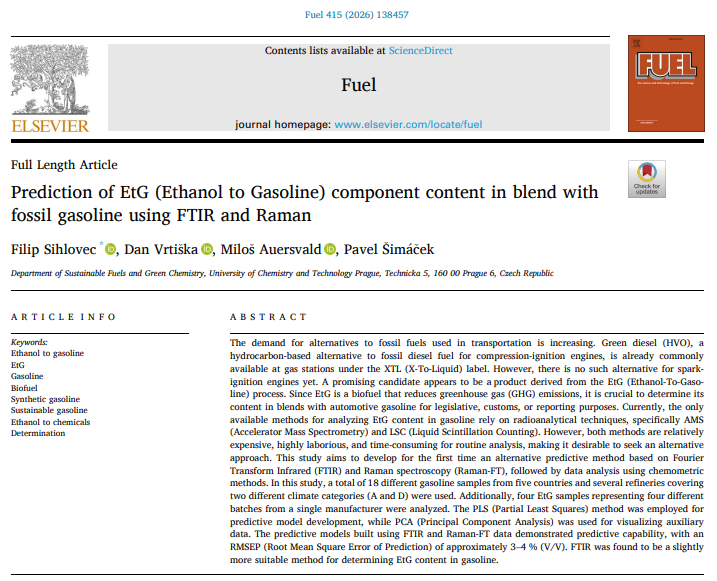
In this study by Filip Sihlovec, Miloš provided a detailed GC×GC characterisation of all samples.
Demand for alternatives to fossil fuels in transportation is increasing. A promising sustainable hydrocarbon-based alternative to fossil gasoline is the product of the EtG (Ethanol-To-Gasoline) process. Because EtG is a biofuel that reduces greenhouse gas (GHG) emissions, it is crucial to determine its content in automotive gasoline blends for legislative, customs, or reporting purposes. Currently, the only available methods for analyzing EtG content in gasoline rely on radioanalytical techniques, specifically AMS (Accelerator Mass Spectrometry) and LSC (Liquid Scintillation Counting).
This study aims to develop for the first time an alternative predictive method based on Fourier Transform Infrared (FTIR) and Raman spectroscopy (Raman-FT), followed by data analysis using chemometric methods. The PLS (Partial Least Squares) method was employed for predictive model development, while PCA (Principal Component Analysis) was used for visualizing auxiliary data. The predictive models built using FTIR and Raman-FT data demonstrated predictive capability, with an RMSEP (Root Mean Square Error of Prediction) of approximately 3–4 % (V/V). FTIR was found to be a slightly more suitable method for determining EtG content in gasoline.
Feel free to read this work: https://www.sciencedirect.com/science/article/pii/S0016236126002103
