
NEW publication in Waste Management
In this work by Anas Abdulrahman, Miloš contributed during his PostDoc stay at LCT UGent.
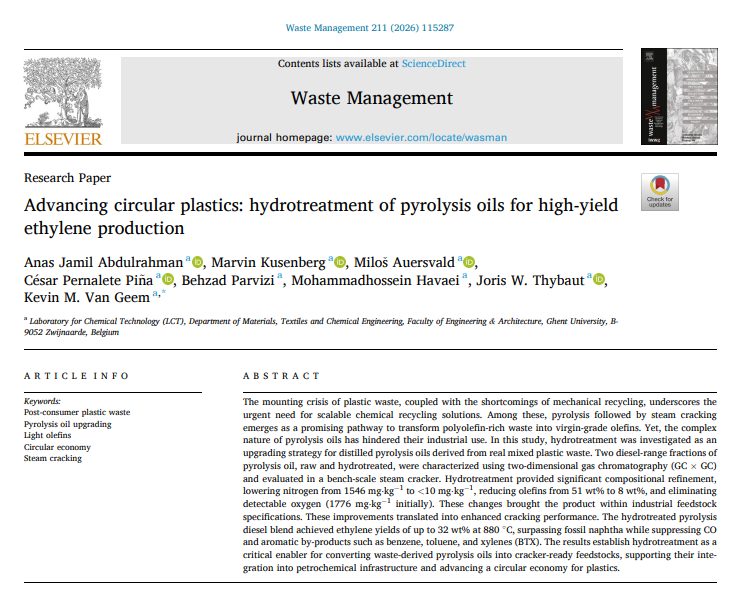
In this study, hydrotreatment was investigated as an upgrading strategy for distilled pyrolysis oils derived from real mixed plastic waste. Two diesel-range fractions of pyrolysis oil, raw and hydrotreated, were characterized using two-dimensional gas chromatography (GC × GC) and evaluated in a bench-scale steam cracker. Hydrotreatment provided significant compositional refinement, lowering nitrogen from 1546 mg·kg−1 to <10 mg·kg−1, reducing olefins from 51 wt% to 8 wt%, and eliminating detectable oxygen (1776 mg·kg−1 initially). These changes brought the product within industrial feedstock specifications. These improvements translated into enhanced cracking performance. The hydrotreated pyrolysis diesel blend achieved ethylene yields of up to 32 wt% at 880 °C, surpassing fossil naphtha while suppressing CO and aromatic by-products such as benzene, toluene, and xylenes (BTX). The results establish hydrotreatment as a critical enabler for converting waste-derived pyrolysis oils into cracker-ready feedstocks, supporting their integration into petrochemical infrastructure and advancing a circular economy for plastics.
Feel free to read this open-access work: https://www.sciencedirect.com/science/article/pii/S0956053X25006981
