
NEW publication in Energy & Fuels
In this work by Ehsan Mahmoudi, Miloš contributed during his PostDoc stay at LCT UGent.
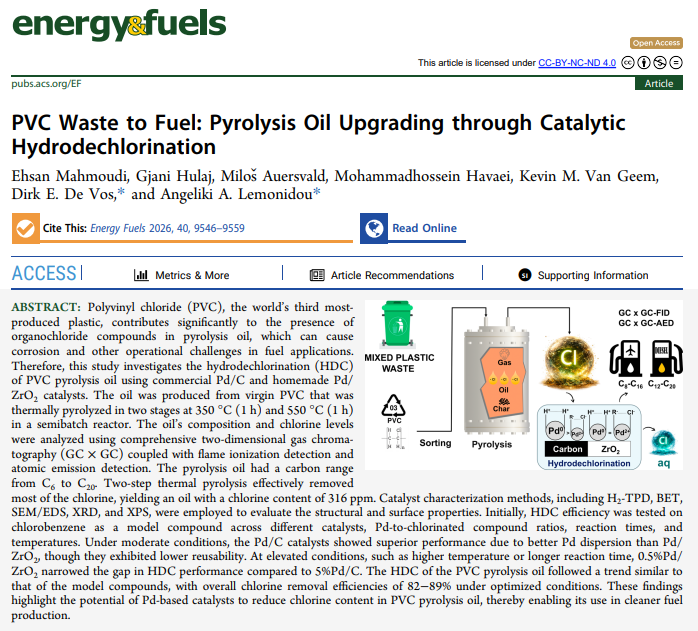
Polyvinyl chloride (PVC), the world’s third most-produced plastic, contributes significantly to the presence of organochloride compounds in pyrolysis oil, which can cause corrosion and other operational challenges in fuel applications. Therefore, this study investigates the hydrodechlorination (HDC) of PVC pyrolysis oil using commercial Pd/C and homemade Pd/ZrO2 catalysts.
Two-step thermal pyrolysis effectively removed most of the chlorine, yielding an oil with a chlorine content of 316 ppm. The HDC of the PVC pyrolysis oil followed a trend similar to that of the model compounds, with overall chlorine removal efficiencies of 82–89% under optimized conditions. These findings highlight the potential of Pd-based catalysts to reduce chlorine content in PVC pyrolysis oil, thereby enabling its use in cleaner fuel production.
Feel free to read this open-access work: https://doi.org/10.1021/acs.energyfuels.6c00289
