
NEW publication in Microchemical Journal
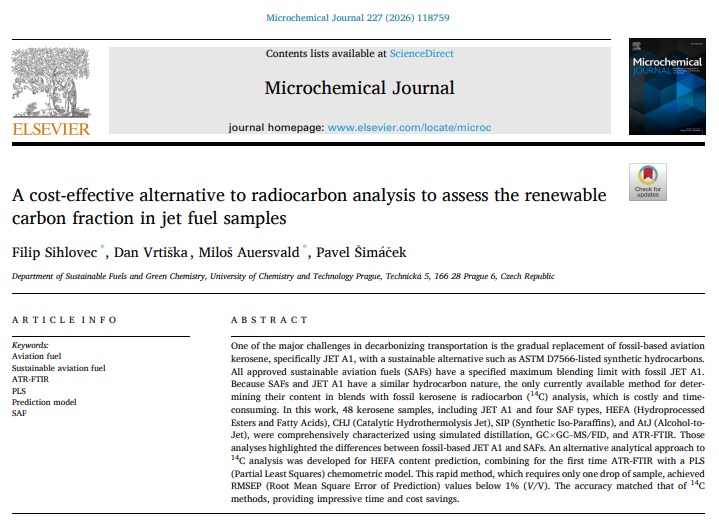
In this study by Filip Sihlovec, Miloš contributed by providing a detailed GC×GC characterisation of all samples and by managing the submission.
One of the major challenges in decarbonizing transportation is the gradual replacement of fossil-based aviation kerosene with sustainable aviation fuels (SAFs). Because SAFs and JET A1 have a similar hydrocarbon nature, the only currently available method for determining their content in blends with fossil kerosene is radiocarbon (14C) analysis, which is costly and time-consuming. In this work, 48 kerosene samples, including JET A1 and four SAF types, HEFA (Hydroprocessed Esters and Fatty Acids), CHJ (Catalytic Hydrothermolysis Jet), SIP (Synthetic Iso-Paraffins), and AtJ (Alcohol-to-Jet), were comprehensively characterized using simulated distillation, GC×GC–MS/FID, and ATR-FTIR. Those analyses highlighted the differences between fossil-based JET A1 and SAFs. An alternative analytical approach to 14C analysis was developed for HEFA content prediction, combining for the first time ATR-FTIR with a PLS (Partial Least Squares) chemometric model. This rapid method, which requires only one drop of sample, achieved RMSEP (Root Mean Square Error of Prediction) values below 1% (V/V). The accuracy matched that of 14C methods, providing impressive time and cost savings.
Feel free to read this open-access work: https://www.sciencedirect.com/science/article/pii/S0026265X26019612
