
NEW publication in Chemical Engineering Journal Advances
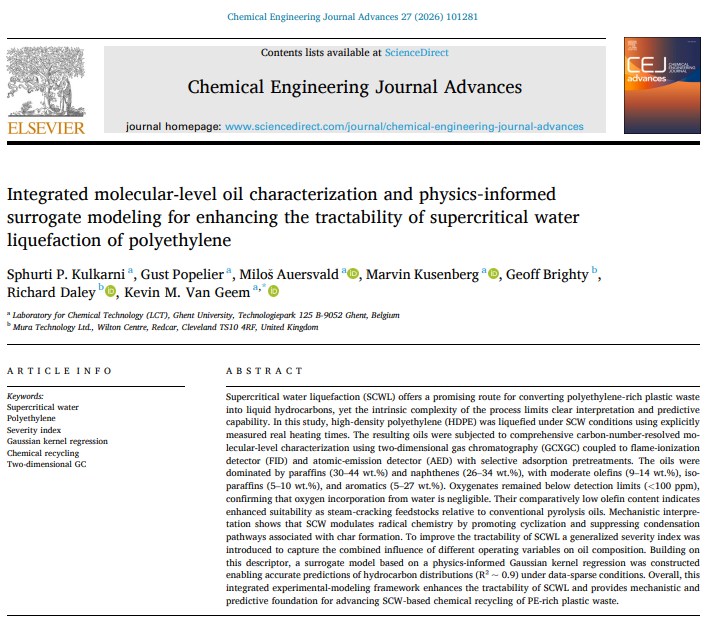
In this work by Anas Abdulrahman, Miloš contributed during his PostDoc stay at LCT UGent.
Supercritical water liquefaction (SCWL) offers a promising route for converting polyethylene‑rich plastic waste into liquid hydrocarbons, yet the intrinsic complexity of the process limits clear interpretation and predictive capability. In this study, high‑density polyethylene (HDPE) was liquefied under SCW conditions using explicitly measured real heating times. The produced oils were dominated by paraffins (30–44 wt.%) and naphthenes (26–34 wt.%), with moderate olefins (9–14 wt.%), isoparaffins (5–10 wt.%), and aromatics (5–27 wt.%). Oxygenates remained below detection limits (<100 ppm), confirming that oxygen incorporation from water is negligible. Building on the introduced severity index, a surrogate model based on a physics-informed Gaussian kernel regression was constructed, enabling accurate predictions of hydrocarbon distributions (R² ∼ 0.9) under data‑sparse conditions. Overall, this integrated experimental-modelling framework enhances the tractability of SCWL and provides a mechanistic and predictive foundation for advancing SCW‑based chemical recycling of PE-rich plastic waste.
Feel free to read this open-access work: https://www.sciencedirect.com/science/article/pii/S2666821126002498
